
Lucky Yatra
FCB India turned Mumbai's suburban train tickets into lottery entries — and won India's only Grand Prix at Cannes 2025.
2025
The write-up
Overview
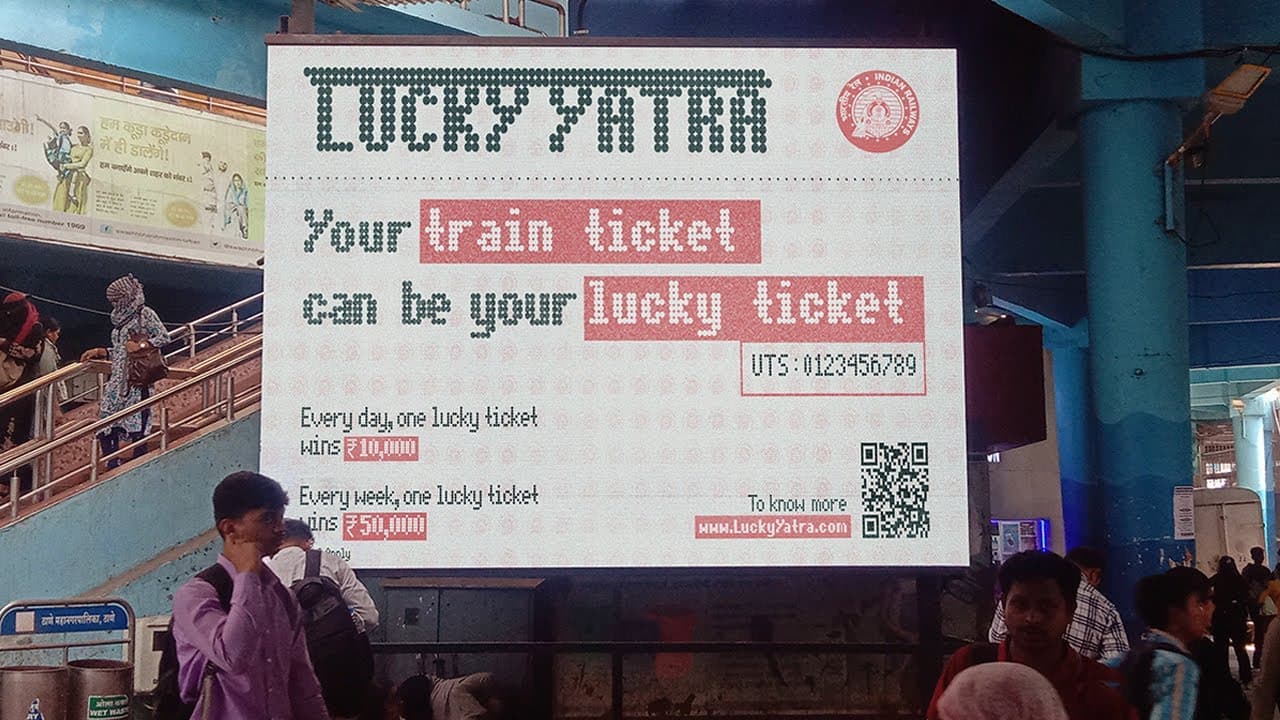
Lucky Yatra transformed Mumbai's suburban railway tickets into lottery entries with daily cash prizes of ₹10,000 and weekly prizes of ₹50,000. Created by FCB India, it won India's only Grand Prix at Cannes 2025 in PR, along with six Gold Lions, making it India's top-performing Cannes campaign that year.
Problem
Indian Railways loses over $800 million yearly due to ticketless travel. In Mumbai, 41% of 7.5 million daily commuters travel without valid tickets. Traditional fines and checks failed as there was no positive incentive for honest passengers.
Solution
Leveraging India's $28 billion lottery market, FCB India made each train ticket a lottery ticket with unique numbers entering daily draws. The campaign spanned OOH at stations, on-train ads, live announcements, radio (Radio Mirchi), and digital channels, ensuring wide visibility.
Outcome
Lucky Yatra boosted public engagement, garnered coverage in 350+ media outlets, increased ticket sales, and positively influenced commuter behavior. It demonstrated that creativity can encourage civic responsibility without coercion and contributed to India's record 32-Lion win at Cannes 2025.
“It proved creativity can buy civic responsibility without spending a single rupee on coercion.”
The evidence
01 / 04 · Campaign still
- Brand
- Indian Railways
- Industry
- Transport / Public Services
- Sub-category
- Railways / Public Transport
- Medium
- Integrated Campaign
Related case files
Related case files
 Decoded
5 Must-Watch Picks for Every Marketer
From Mad Men's Don Draper to the true story behind Air Jordan, five films and series that teach marketers more than most textbooks do.
 Decoded
YouTube Just Raised the Price of Entry for Creators
From February 2027, YouTube is doubling the performance bar for new creators to monetise — a signal that consistency now matters more than virality.
 Gold · Cannes 2025
Tailor Test
Waist and hip measurements taken at the local tailor, used to screen for heart-disease risk — Gold in Creative Data at Cannes 2025.